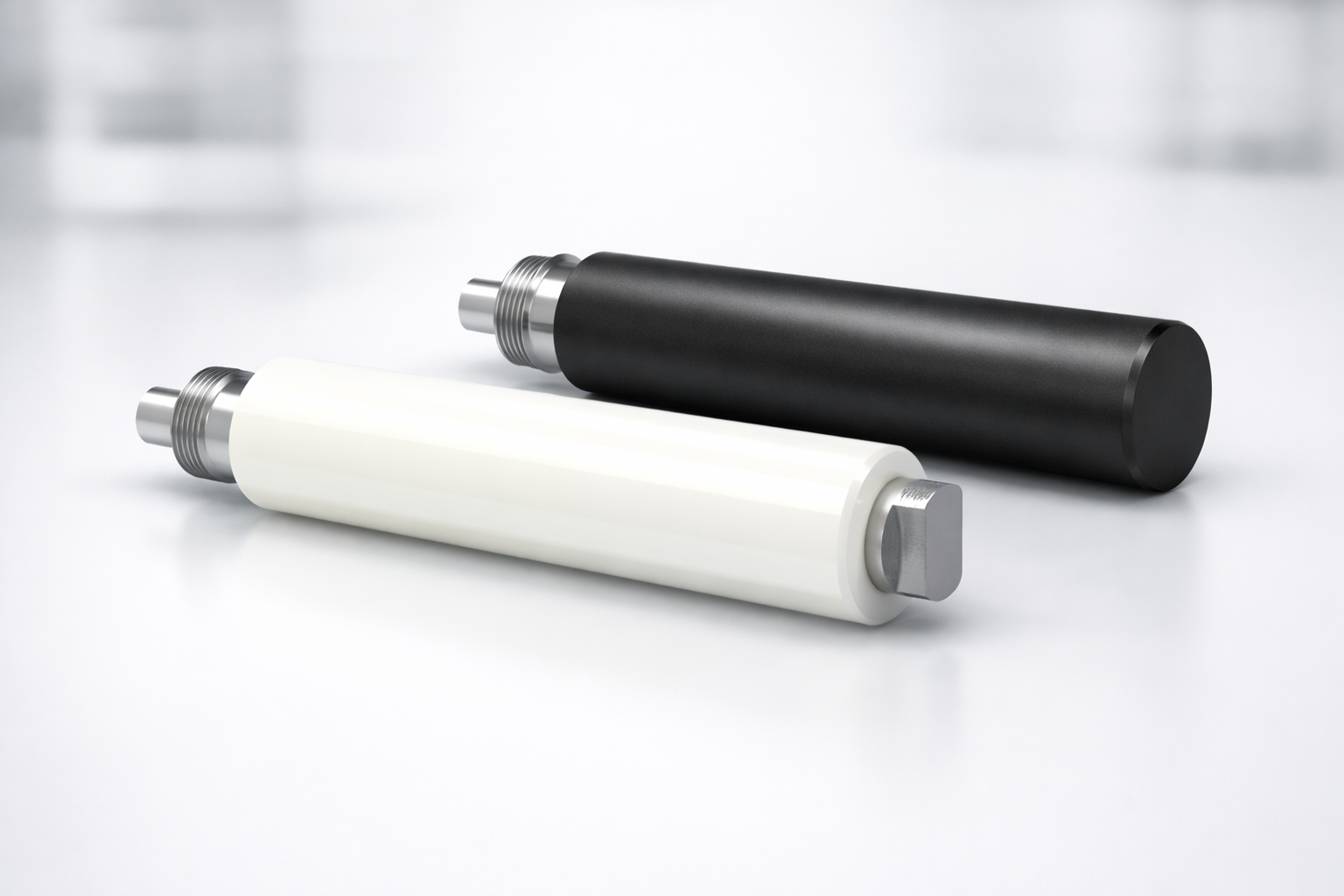


Seawater desalination by reverse osmosis (RO) is a highly demanding process from a mechanical, chemical and operational point of view. In this context, there is one component with a direct – and often underestimated – impact on efficiency, maintenance frequency and operating costs: the high-pressure pump piston.
Traditionally, these pistons have been made of stainless steel or other metal alloys. However, in real operating conditions – where high pressure, salinity and abrasive particles coexist – these materials present limitations that inevitably lead to their degradation.
Ceramic pistons represent a step change in the way these challenges are addressed, not only from a material standpoint, but also in terms of system reliability and long-term cost optimization.
The critical role of the piston in reverse osmosis (RO) systems
In a reverse osmosis desalination plant, seawater is pressurized and forced through a semi-permeable membrane to separate salts and contaminants. This process normally requires pressures of between 60 and 80 bar, although they can be higher depending on the system design.
The generation of this pressure is directly dependent on the performance of the high pressure pump. At the heart of this pump is the piston, responsible for compressing the water and maintaining continuous operating cycles. It is a component in constant motion, in direct contact with a chemically aggressive fluid and in continuous interaction with dynamic sealing systems.
In industrial desalination applications, the pistons are usually large, with diameters ranging from 60 mm to 120 mm. At this scale, they are subjected to significant mechanical loads. Add to this the presence of sand, suspended solids and dissolved salts, and the working environment becomes particularly aggressive. As a result, the piston is one of the main wear elements in the entire system.
Why do metal pistons fail in desalination applications?
The limitations of metal pistons in desalination are not circumstantial, but inherent to the behavior of metals in these conditions.
From a mechanical point of view, seawater generates a continuous abrasive effect. Even with pretreatment systems, fine particles and sediments reach the pump. Over time, these particles cause micro-scratches on the piston surface. This progressive degradation increases friction and alters the interaction between the piston and sealing systems.
At the same time, a chemical degradation mechanism takes place. Chlorides present in seawater are particularly aggressive for metals, even for high quality stainless steels. The result is often the appearance of localized corrosion phenomena, such as pitting, which progressively deteriorate the integrity of the component.
These two mechanisms – abrasion and corrosion – act in combination, accelerating wear. As the surface deteriorates, sealing systems are affected: friction increases, leakage occurs and seal life is significantly reduced. What initially appears to be a one-off piston problem becomes an overall system problem.
Operationally, this translates into more frequent maintenance, unplanned shutdowns and increased costs for spare parts and labor. In plants that operate continuously (24/7), these inefficiencies have a direct economic impact.
Ceramic pistons: a solution designed for demanding environments
Ceramic materials offer a completely different response to the challenges of desalination. Instead of reacting to wear and corrosion, they are inherently resistant to both.
Technical ceramics such as alumina (Al₂O₃) and zirconia (ZrO₂) are characterized by their high hardness, generally in the range of 1200 to 1400 HV. This property significantly reduces abrasive wear compared to metals. In addition, the ceramics are chemically inert to seawater and chlorides, eliminating corrosion mechanisms.
Another key feature is their surface finish. Thanks to high-precision manufacturing processes, these components achieve extremely low roughness, typically below Ra 0.2 µm. This mirror-polished surface minimizes friction and ensures stable interaction with the sealing elements over time.
In addition, ceramics maintain excellent dimensional stability under high pressure. Unlike metals, they do not undergo plastic deformation under load, which allows them to maintain constant tolerances throughout the life of the component. This aspect is essential to ensure the performance of the sealing system under high pressure conditions.
Ceramic vs metallic pistons: a real-world performance comparison
When comparing ceramic and metallic pistons, the differences are not only observed in the material properties, but also in the actual behavior in operation.
In terms of wear resistance, ceramic pistons generally offer several times longer service life. Depending on the operating conditions, it is common to achieve 3 to 10 times longer lifetimes. This is mainly due to the absence of adhesive wear and much slower abrasive degradation.
Corrosion resistance is another key differentiating factor. While metals are susceptible to chemical attack in saline environments, ceramics remain stable and unaltered. This ensures that the piston surface does not degrade over time due to chemical reactions.
One of the most relevant indirect benefits is the impact on sealing systems. By maintaining a stable and polished surface, seals experience less friction and wear. In practice, this can translate into seal life increases of 50% to 200%, significantly reducing maintenance needs.
From an economic point of view, although the initial cost of ceramic pistons is higher, it must be evaluated in terms of total cost of ownership. Reduced maintenance, less downtime and longer component life result in clear overall savings.
Why ceramics work better: material behavior
The improved performance of ceramics in desalination is not only due to their hardness, but also to how they interact with the environment.
Metals are prone to both adhesive and abrasive wear. Adhesive wear, in particular, accelerates surface deterioration due to frictional material transfer. Ceramics, on the other hand, exhibit mainly abrasive wear, and at a much slower rate due to their hardness.
From a chemical point of view, metals tend to react with their environment, especially in the presence of chlorides. This generates corrosion processes that weaken the material. Ceramics, being chemically inert, completely eliminate this failure mechanism.
As for the interaction with seals, the differences are equally relevant. Metallic surfaces develop irregularities over time that progressively damage the sealing elements. Ceramic surfaces, on the other hand, remain stable, providing a constant contact interface throughout their service life.
Alumina vs zirconia: how to choose the right material
The choice between alumina and zirconia depends on the specific operating conditions.
Alumina is widely used in desalination because of its balance between cost and performance. It offers high hardness, excellent chemical resistance and reliable performance under standard conditions. For many installations, it represents the most efficient solution.
Zirconia, on the other hand, provides greater toughness and resistance to mechanical stress. It is particularly suitable for applications with higher dynamic loads, possible impacts or more demanding conditions. Although its cost is higher, it can provide greater reliability in critical environments.
Selection should be based on factors such as mechanical loads, pretreatment quality, continuity of operation and system criticality.
Design considerations for ceramic pistons
Material selection alone is no guarantee of performance. The design and manufacture of the piston are equally decisive.
Ceramic pistons are usually designed as a ceramic functional body combined with a metallic interface that allows their integration into the pump. This junction must be properly designed to ensure adequate load transmission and high reliability under cyclic conditions.
Surface finish is critical, as seal interaction is directly dependent on surface quality. Tight tolerances and controlled roughness are essential to ensure seal performance and minimize wear.
These considerations are even more important in large diameter pistons, where mechanical stresses are higher and the economic impact of failure is significant. In these cases, design accuracy and material reliability are key.
Where ceramic pistons add most value
Although ceramic pistons can be beneficial in multiple applications, their value is especially evident in certain scenarios:
- Seawater reverse osmosis plants with high salinity and continuous operation
- Systems with limited prefiltration or increased solids presence
- Installations where wear and tear is high
- Continuous processes where stoppages have a high cost
In these environments, increased wear resistance, freedom from corrosion and dimensional stability translate directly into operational and economic improvements.
Conclusion: from higher initial cost to lower operating cost
Replacing metallic pistons with ceramic is not simply a change of material, but a strategic decision that impacts the overall performance of the desalination system.
In saline and abrasive environments, metal components are subject to inevitable degradation. Maintenance becomes a recurring need and downtime generates significant costs.
Ceramic pistons address these problems by reducing wear, eliminating corrosion and stabilizing interaction with sealing systems. The result is more reliable, efficient and predictable operation.
Ultimately, the value of ceramic pistons lies not in their initial cost, but in their ability to reduce overall operating costs and improve long-term system performance. For desalination plants operating under demanding conditions, they represent one of the most effective solutions for increasing reliability and optimizing efficiency.