Waterjet technology has established itself as a key solution in multiple industrial sectors. From the cutting of complex materials to hydrodemolition and industrial cleaning, its ability to work without heat generation and with high precision makes it an extremely versatile tool.
However, there is one critical factor that is often overlooked: the performance of the system depends not only on the pump or the overall design, but on a much more specific component: the piston.
In systems that can exceed 6,000 bar, any deviation in materials, tolerances or wear behavior has a direct impact on efficiency, service life and operating costs. This is where ceramic pistons make a clear difference compared to traditional solutions.
Why are ceramic plungers critical in waterjet systems?
To understand its importance, it is necessary to analyze how a waterjet system works. These systems generate extremely high pressures in a fluid that is then used for cutting or cleaning.
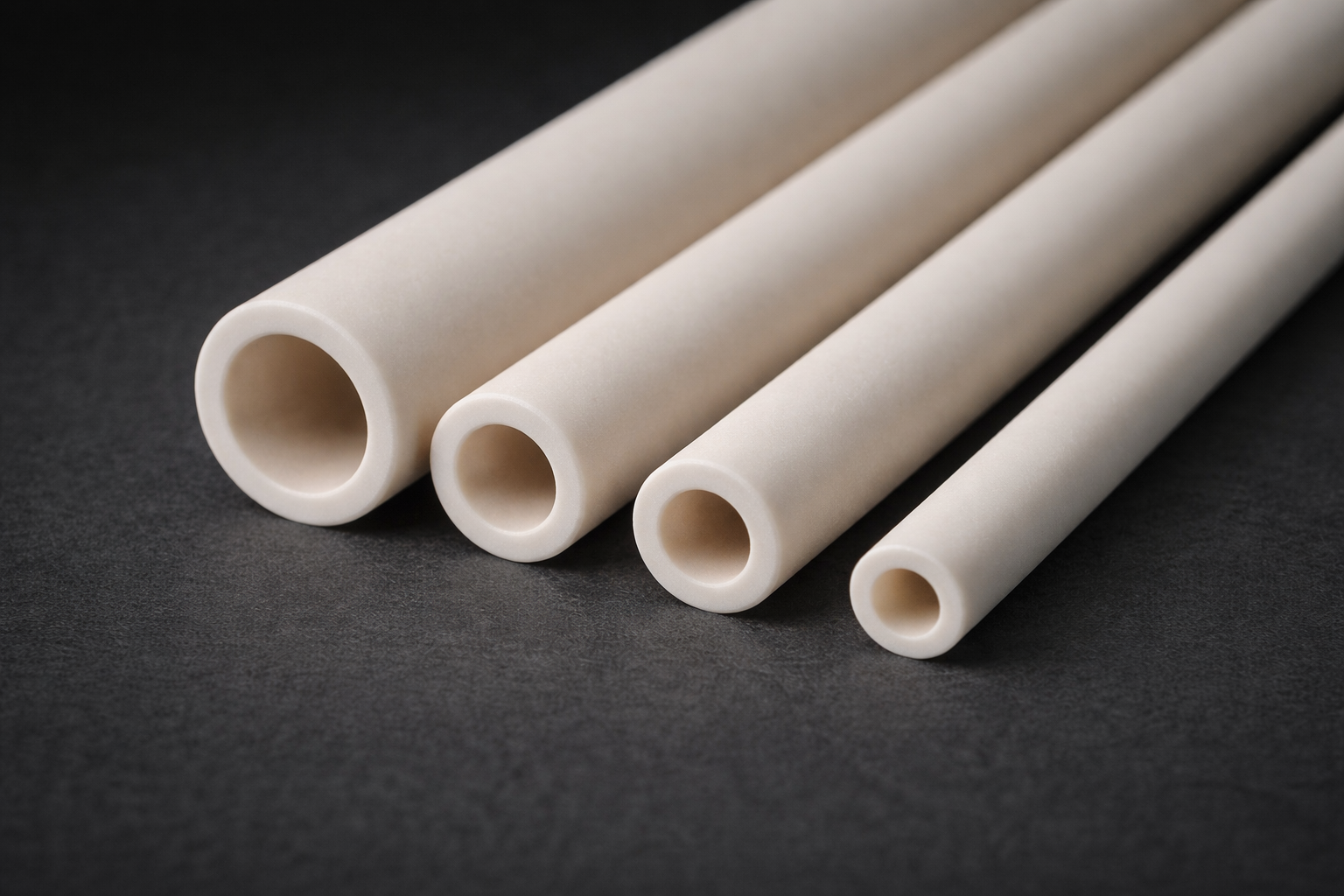
The ceramic plunger is responsible for compressing this fluid continuously. This means that it works simultaneously under pressure, friction, constant contact with seals and, in many cases, under demanding chemical and thermal conditions.
It is not a passive component, but a dynamic element operating under thousands of cycles. Any degradation directly affects system performance.
When the ceramic plunger loses dimensional accuracy or its surface deteriorates, problems begin to appear: leaks, loss of pressure and increased maintenance. What initially appears to be a minor failure ends up affecting productivity.
Therefore, ceramic pistons in waterjet systems should not be considered as simple spare parts, but as key elements in the overall performance of the system.
Pressure vs. piston diameter: the key factor that defines performance
There is a fundamental principle that is often underestimated: the higher the pressure, the smaller the piston diameter.
This has direct implications for both design and material selection. In low to medium pressure systems, diameters are typically between 30 and 45 mm. As pressure increases, the diameter is progressively reduced: 20-30 mm in medium pressure, 12-20 mm in high pressure and down to 8-12 mm in ultra-high pressure systems.
This reduction is not trivial. A smaller diameter implies a higher pressure per unit area, which significantly increases the mechanical stresses on the material. In addition, any surface imperfections or deviations in tolerances become much more critical.
Precision in manufacturing is no longer important but essential. Surface roughness (Ra) directly affects sealing performance. If the surface is not adequate, seals wear faster, leakage occurs and efficiency decreases.
In addition, wear is concentrated on a smaller surface area, accelerating degradation if the material is not suitable.
This is one of the main reasons why metal pistons have clear limitations in high-pressure environments.
Which ceramic material to choose: alumina, zirconia or silicon carbide?
Material selection is not a secondary decision: it directly determines the performance and service life of the piston.
Alumina (Al₂O₃) is the most commonly used material in standard applications. Its high hardness and good wear resistance make it a balanced solution in terms of cost and performance. It works reliably in many waterjet systems, especially in stable conditions.
However, not all applications are the same. Where vibrations, dynamic loads or risk of microcracking are present, zirconia (ZrO₂) offers a key advantage: higher toughness. This means greater resistance to crack propagation and more robust behavior under demanding conditions.
Silicon carbide (SiC), on the other hand, is oriented to extreme environments. Its high thermal resistance, high thermal conductivity and excellent chemical resistance make it ideal for applications involving thermal shock or aggressive fluids.
The key is not to choose “the best material”, but the most suitable for the actual working conditions: pressure, type of fluid (pure water or with abrasives), operating cycles and thermal conditions.
A selection without this analysis usually leads to operational problems.
Common problems with metal pistons in waterjet systems
Metal pistons have been the traditional solution, but their limitations in high-pressure systems are obvious.
Wear is one of the first problems. Under continuous friction, metals degrade more rapidly, affecting both surface quality and dimensional accuracy. This directly impacts sealing and system efficiency.
Corrosion is another critical factor. Constant exposure to water – especially if it contains additives or impurities – accelerates material degradation. This not only reduces service life, but also generates surface defects that affect performance.
This is compounded by thermal deformation and mechanical fatigue. Under high pressure and continuous cycling, metals can undergo cumulative deformations that affect performance.
The result is well known: frequent downtime, recurring replacements and increased operating costs. This is where a key concept comes into play: cost per cycle.
Advantages of ceramic pistons in high pressure applications
Ceramic pistons offer a much more stable and reliable solution.
High wear resistance allows performance to be maintained for longer. Surface degradation is much slower, which helps maintain sealing efficiency and system pressure.
They also stand out for their excellent dimensional stability, especially critical in high-pressure systems where small deviations cause major problems.
Another important advantage is their chemical resistance. Unlike metals, technical ceramics are not affected by corrosion, which prolongs their service life even in aggressive environments.
All this translates into a significantly longer service life. But more importantly, it reduces maintenance interventions and improves system stability.
From a cost-per-cycle perspective, ceramic pistons clearly outperform metallic alternatives.
Industrial waterjet applications and piston requirements
Waterjet systems are used in multiple industries, each with specific needs.
In industrial cutting (metal, stone, ceramics, composites), precision and pressure stability are critical. Any variation directly affects the quality of the cut.
In hydrodemolition, durability and wear resistance are essential due to the harsh conditions and long working cycles.
In industrial cleaning, especially in heat exchangers or piping, operational continuity is key. Unplanned shutdowns have a direct impact on production.
Sectors such as food, aeronautics or automotive add additional requirements such as high precision and absence of thermal deformation.
In all these cases, the piston is not a standard component: it must be adapted to the application.
Key design factors in ceramic pistons (where the real value is generated)
It is in the design where the true differentiation lies.
Surface roughness is not a minor detail. A properly controlled Ra value is essential to guarantee sealing and avoid premature wear of components.
Dimensional tolerances are equally critical. In high-pressure systems, small deviations can lead to leakage or efficiency losses.
Compatibility with sealing systems is another key issue. Not all designs work the same in all pump configurations, and a mismatch can compromise the entire system.
Finally, it is essential to adapt the design to the actual working conditions: pure water, abrasive fluids, continuous operation or intermittent cycles.
This is where a standard supplier differs from a true technical partner.
Beyond the component: how to optimize a complete waterjet system
In many cases, the traditional approach is to replace components when they fail, without questioning whether the solution is the right one from the start.
This approach may be valid in low-demanding environments, but not in high-pressure systems.
Optimizing a waterjet system involves understanding the interaction between all its components and adapting each one to the actual operating conditions. The piston, because of its central function, is one of the elements with the greatest impact.
It is not just a matter of choosing a material, but of defining geometry, tolerances and surface finish according to the application.
When this approach is applied correctly, the result is not only a longer service life, but an overall improvement of the system: less maintenance, greater stability and reduced operating costs.
In this context, Steelceram positions itself not as a component supplier, but as a technical partner in the optimization of high-pressure systems.
Conclusion
In waterjet systems, performance does not depend only on the pump or the pressure reached, but on the actual behavior of each component.
The piston, due to its function and the conditions to which it is subjected, is one of the most critical elements.
Understanding the relationship between pressure and diameter, selecting the correct material – alumina, zirconia or silicon carbide – and designing for the actual conditions of use are key factors.
When the analysis moves from unit price to cost per cycle, the decision is no longer a purely technical one, but a strategic one.