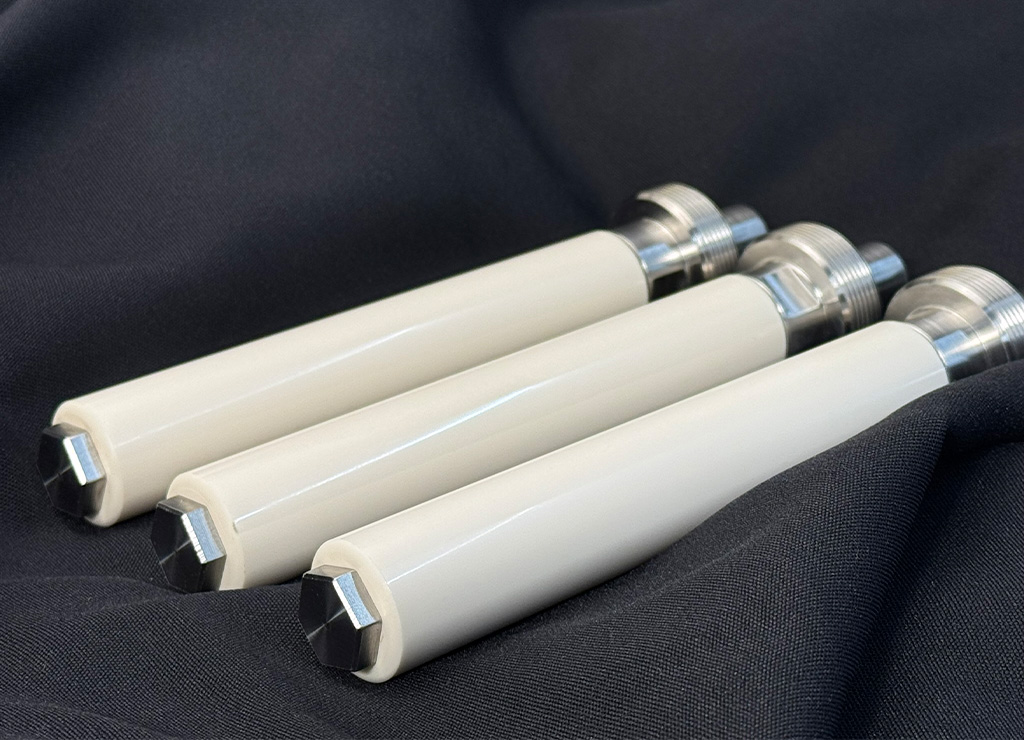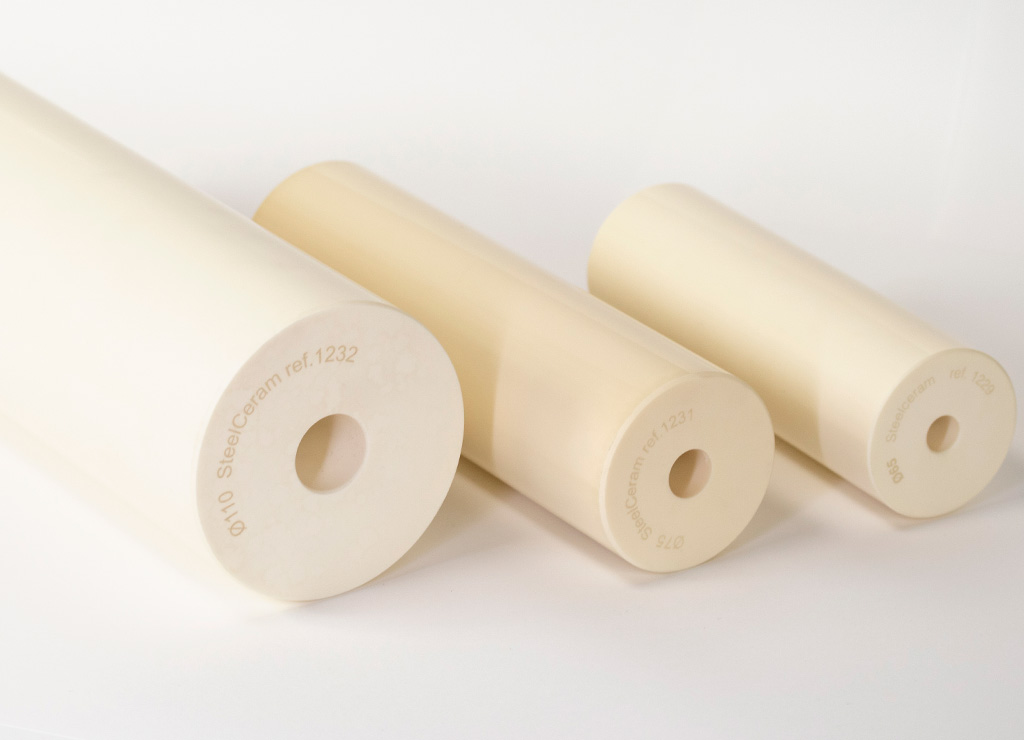
We manufacture ceramic rods for wire drawing in alumina 99%.
Ceramic drawing rods manufactured by Steelceram offer a highly specialized ceramic solution for demanding industrial applications. While steel and carbide still dominate many industrial catalogs, a discreet but profound transformation is taking place on the margins of innovation: the replacement of metals with advanced ceramics. In the case of wire drawing, this evolution is not just a question of technical performance, but of a smarter manufacturing philosophy, where durability, energy efficiency and precision become strategic pillars. Ceramic rods, traditionally seen as a luxury or a rarity, are beginning to reveal their true potential: not as alternatives, but as the new standard for those who are no longer satisfied with the standard. This article proposes a different view, not from a marketing perspective, but from the logic of those who are committed to making better products.
2. What are ceramic rods and why are they used in wire drawing?
In a process as repetitive and critical as wire drawing, where constant friction generates extreme temperatures and accelerated wear, ceramic rods are not just spare parts: they are strategic elements. Unlike conventional materials, these rods not only resist – they transform the working environment. Their insertion in wire drawing lines has been shown to reduce micro-vibrations, stabilize the wire pitch and significantly reduce surface defects in the final product. This impact is often not documented, but is palpable in continuous quality and reduced unplanned maintenance.
2.1. Technical definition and properties of a ceramic rod
A ceramic rod is, in essence, a cylindrical body made from advanced materials such as alumina, precision-molded and sintered at high temperature to achieve hardnesses rivaling those of diamond. But what many fail to note is their anomalous behavior in the face of thermal fatigue: these parts not only resist heat – they manage it – dissipating energy in a way that stabilizes operating conditions. Their dimensional stability, even in aggressive thermal cycles, allows constant tolerances without deformation, which is crucial in drawing machines operating at high speed.
2.2. Advantages over traditional materials such as steel or carbide
Steel wears away. Carbide chips. Ceramic holds up. The paradox is that, despite its reputation for brittleness, technical ceramics – when properly designed and treated – outperform both materials not only in service life but also in consistency. While a metallic component changes its properties over time due to oxidation, stress or fatigue, ceramics retain their characteristics almost unchanged. This chemical and mechanical stability is especially valuable in processes with minimal tolerances. In addition, its low coefficient of friction reduces the need for lubrication, which in the long term also has ecological and sustainability implications for the production line.
3. Alumina 99%: key material in high-performance ceramic rods
Not all ceramics are equal, and within that universe, 99% alumina stands out not only for its hardness, but also for its ability to deliver repeatable precision under aggressive industrial conditions. This purity allows for a highly stable crystalline structure, which reduces the risk of internal porosity and micro-cracks, critical factors in parts subjected to continuous stress such as drawing rods. Its wear resistance is often mentioned, but what few mention is its ability to dampen small vibrations in contact with the metal wire, reducing the risk of deviations and improving the dimensional control of the final product.
3.1. Physicochemical properties of pure alumina
Alumina 99% has a Mohs hardness close to 9, high dielectric strength and low thermal conductivity, which makes it an excellent insulator. But its true value lies in its predictable behavior. Unlike other composite materials, it does not vary significantly with humidity, nor does it oxidize or react with drawn metals. This chemical neutrality makes it ideal for processes where the slightest residue or surface contamination can compromise wire quality. In addition, its resistance to abrasion makes it possible to maintain the internal tolerances of the guides during thousands of kilometers of continuous production.
3.2. Specific applications on wire drawing machines
Alumina rods are mainly used as wire guides, contact rollers or inserts in high friction areas of drawing lines. Their role is not passive: they regulate the wire passage, align the tension and protect the metal elements from premature wear. In particular, in copper, aluminum or stainless steel drawing, the use of ceramic bars has made it possible to increase production speed without compromising precision. This improvement is not achieved simply by the strength of the material, but by its ability to remain stable over time, becoming a technical ally, not just a wear part.

4. The value of external polishing on alumina ceramic rods for wire drawing.
In the context of wire drawing, where every micron counts, the surface finish of a ceramic rod is not a minor detail: it is a determining factor for the efficiency of the process. High-precision technical polishing reduces friction between the wire and the ceramic surface, reducing wear on both the wire and the rod itself, and avoiding defects such as cuts, metallic build-up or deviations in the trajectory. This smooth finish allows a smoother wire passage, improves heat dissipation and contributes to a higher production speed with less maintenance. At Steelceram, our 99% alumina rods are polished by grinding and diamond grinding processes, achieving roughnesses of less than 0.2 µm. The result is a more stable, more accurate rod with sustained performance over time. It’s not just ceramics: it’s surface engineering applied to the heart of the process.
Where to get industrial quality alumina ceramic rods?
In a market saturated with distributors and generic catalogs, getting truly industrial ceramic rods means more than finding a supplier: it means partnering with a manufacturer that understands the nuances of your process. Many companies purchase “catalog” rods that do not meet either exact dimensions or surface tolerances, compromising the entire production line. Steelceram positions itself as a technical partner, not just a supplier. We manufacture to drawing, adapting to the customer’s real requirements and guaranteeing continuity in quality and supply, two critical aspects when looking for industrial standardization in the medium and long term.
5.1. How to identify a reliable supplier
A reliable supplier is not defined by its price, but by its traceability, technical responsiveness and control over the production process. It is essential that whoever manufactures the rods masters the behavior of ceramic materials, from powder formulation to heat treatment. In addition, it must offer verifiable technical documentation, rapid prototyping and batch repeatability. The absence of these factors is one of the main causes of premature failure on wire drawing lines. Asking about these elements is no longer a formality but a prevention strategy.
5.2. Steelceram: direct manufacturing and total control from ceramic powder to final part
At Steelceram we do not buy parts or subcontract them: we create them from scratch. Our process integrates knowledge of the material, mastery of molding, sintering, grinding and polishing. This approach allows us to work to custom specifications with tight tolerances, which is especially important on rods for wire guides, where the slightest dimensional error can result in wire breakage, misalignment or loss of surface quality. In addition, by manufacturing directly, we guarantee continuity in the quality of each batch, with full traceability of materials and firing parameters that other suppliers rarely share.
6. Real-life use cases: why ceramic guides are game changers
Industrial testimonials are not built on slogans, but on hours of uninterrupted production. Several Steelceram customers in Europe have documented significant increases in the service life of their components by replacing metal rods with alumina ceramic rods. The improvement is not only quantitative (fewer replacements, less maintenance), but also qualitative: better wire alignment, reduced breakage and increased drawing speed without sacrificing control. These benefits have a silent but profound impact on overall operational efficiency and process predictability.
In copper drawing, where precision and wire cleanliness are critical, ceramic guides allow stable diameters to be maintained without material carryover. In aluminum, their low friction reduces the risk of sticking. And in stainless steel, where temperatures are high and wear is intense, alumina demonstrates far superior resistance to treated steel. In all these cases, our customers have been able to reduce the number of maintenance shutdowns and the frequency of spare parts, resulting in a real improvement in OEE (Overall Equipment Effectiveness).
7. Conclusion: Are you still using steel where you should have ceramic?
The wire drawing industry is not static, although many of its machines appear to be. The most significant advances in recent years have not come from disruptive technological revolutions, but from smart material decisions. Using 99% alumina rods with a polished finish is not a fad or an elitist solution: it is an engineer’s decision to seek efficiency, stability and durability.
If you are still using metal guides, you may be optimizing what is already obsolete. Ceramic doesn’t just give you longer life: it redefines the standard of what a drawing line can achieve. It’s time to ask yourself if it’s worth continuing to do maintenance every few weeks, or if it’s time to evolve to components that simply don’t fail. At Steelceram, that’s the question we ask ourselves every day: how to make better, not more?